


Smart glasses around children: what happens to the picture?
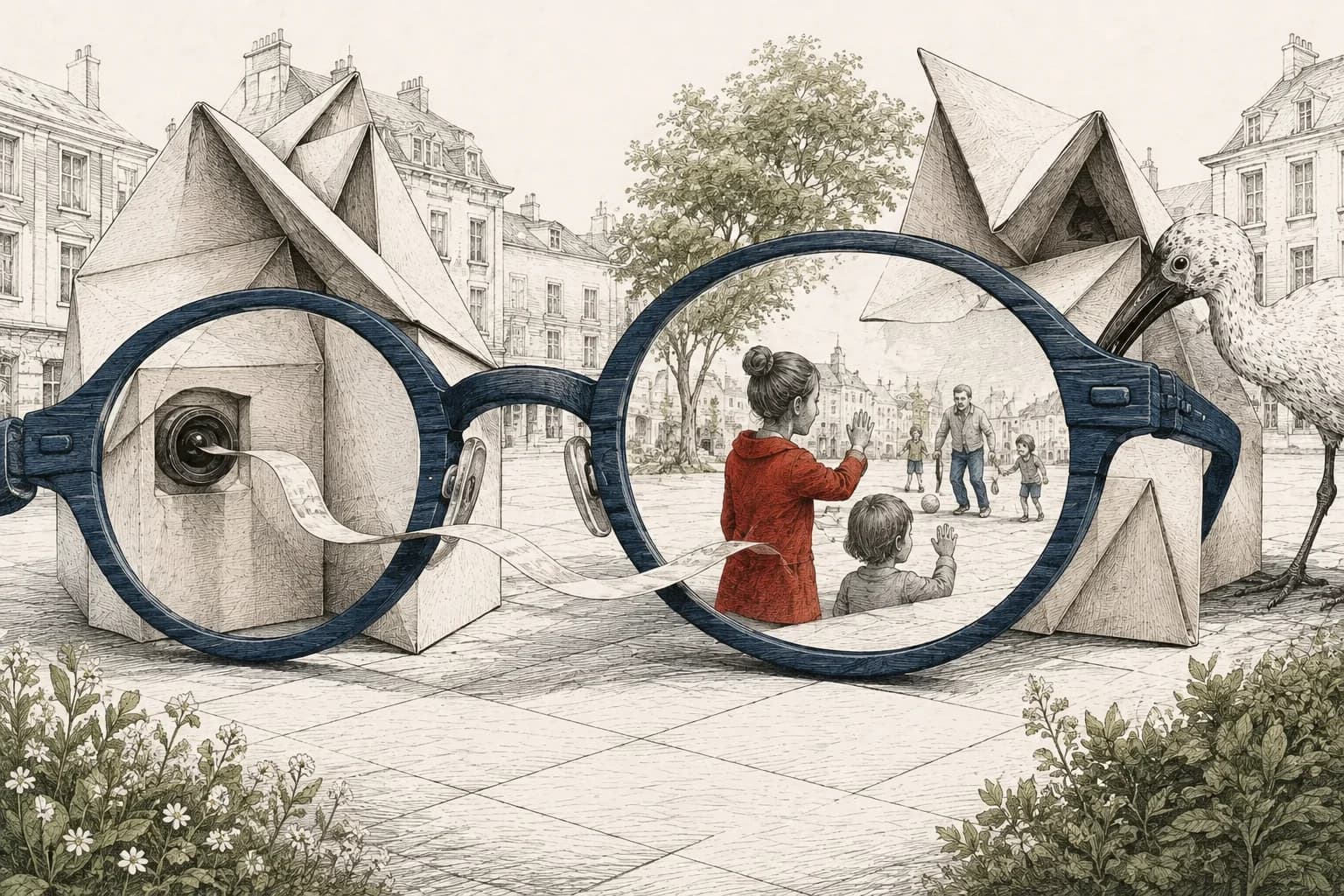
Someone holds up a phone at a birthday party, and you know there's probably a photograph coming. Glasses are harder to read. The person talking to your child may have a camera pointed at them without lifting a hand.
“Please don't post pictures of our kids” leaves room for a recording to be kept, sent privately, or used in an AI request. If those things matter to you too, you need to say so before the picture is taken. And a recording can be used for more than watching the moment again.
A camera can also become the start of a search
In October 2024, Harvard students AnhPhu Nguyen and Caine Ardayfio showed a project called I-XRAY. They connected Ray-Ban Meta glasses to software that could search for faces and then look up personal information online. Their demonstration brought back names and other details about people they filmed. It was a custom system they built, not a feature that came with the glasses. The Harvard project discussion.
The glasses supplied an Instagram livestream. Separate software watched that stream, searched for matching faces in online photographs, and returned information through a phone app. A possible name could lead to an address, a phone number or details about relatives. The address wasn't being read from someone's face; the face helped the software find other records. Contemporary reporting on the setup, 404 Media's interview with Nguyen.
Think of a staff biography with a photograph and a full name. A face search might find that page; a separate search for the name might find an address. Each piece could look unremarkable on its own. The creators' project writeup describes software joining information across different sources.
If you're keeping your children's details private, check your own public information too. A listing under your name may also show an address or relatives' names. The family data-broker guide explains how to find those listings and request removal.
The demonstration had limits. ITV reported that the names were not always right, and the creators said they were not releasing a product. It doesn't tell us how often the system would identify a random family at a playground. A plausible result can still belong to the wrong person. ITV's interview.
The exact setup is not universal either. Meta now lists livestreaming as a Ray-Ban Meta Gen 1 feature. Other cameras can still supply photographs for later searches. What matters is what the person holding the recording does with it. And finding copies of a picture is different from searching for the same face in other photographs.
A photograph and an AI question take different paths
A wearer doesn't need custom identification software to send a picture beyond their own devices. They might take a family photograph to keep on their phone, or ask the glasses to describe something in front of them. Both use the camera, but the image goes to different places.
| What the wearer does | What happens to the image |
|---|---|
| Takes a photo or video for the glasses' gallery | It is stored on the glasses and can be imported to the phone. Sharing and phone backups are separate choices. Gallery storage. |
| Asks Meta AI about what they can see | A photograph goes to Meta's cloud to be processed by AI. Camera-AI requests. |
| Uses a feature that needs Cloud media processing | The image or video may go to Meta for processing and temporary storage, under the separate Cloud media setting. Cloud media. |
Under Meta's US policy, effective June 29, 2026, media used with Meta AI may help improve its products and models. The policy also allows prompts or photographs to be shared with third parties under its AI terms. An image sent to answer one question may therefore be used beyond that answer. Meta's wearable privacy policy.
Sound matters too. If your child says their name while the wearer is speaking to the assistant, that background sound may form part of the voice interaction. Meta's US voice notice says recordings and transcripts are stored by default, generally for up to a year unless deleted sooner, and may be processed by trained reviewers. Turning the camera away does not keep a conversation out of an active microphone. Meta's voice notice.
This is a documented voice-assistant interaction. It doesn't establish that devices secretly record every conversation to choose advertisements; that is a separate question.
Use the recording light as a signal, then talk to the person
Meta glasses have a white capture light. For a gallery photograph, it flashes briefly; for a gallery video, it continues blinking while recording. Meta says the light cannot be switched off and describes protections against covered or tampered-with lights. Meta's capture-light explanation.
A parent can still miss a brief flash. And a light doesn't tell you who will receive the picture, whether it will be uploaded later, or what is already on the wearer's phone. Different brands may use different indicators.
Ask what the glasses are doing. If you want no images of your child taken or sent to AI, a request about posting alone is too narrow:
Please don't record our children or use the camera with AI while they're in view. We're keeping their pictures private, including pictures that aren't posted online.
You don't need to establish bad intentions before making that request. The wearer may never have considered the difference between taking a photo, keeping it and sending it elsewhere.
If the glasses are yours, check the feature you're using
Ask the other parents before taking a picture. If someone wants their child left out, change the angle or wait until the child is out of the frame.
To turn off Cloud media, open the Meta AI mobile app:
- Tap Glasses, then select the correct device if you have several.
- Tap Device settings. Under Glasses, tap your glasses.
- Open Glasses privacy and switch off Cloud media.
Some voice-sharing features need this processing. Meta says Cloud media is stored temporarily for 30 days; deleting media in Gallery also removes it from that cloud storage and the phone's photo app. Meta's Cloud media instructions.
That switch does not make camera-based AI requests local, and the 30-day period is not a deadline for deleting everything the glasses send to Meta. Avoid using the camera with AI around a child whose image should not be sent for processing.
If you used the voice assistant, delete the stored interaction and its transcript in the Meta AI app as well as dealing with the gallery file. Meta's voice notice describes those separate records. Its AI-glasses FAQ says deletion stops the information being used in future training but doesn't change a model that has already learned from it at that moment.
Check phone backups after importing a picture too. If you share an edited copy, the original can still be in your library. The wider privacy check follows the account, caption and sound as well as the visible face.
Give the school or host a request they can use
At a club or school event, ask the organizer to include camera glasses in the same photography instructions they give phone users:
Could you include camera glasses in the photography reminder? Please ask people to get permission before recording children, and to avoid camera-based AI around children whose families have opted out of photographs.
Tell the organizer how to identify your child privately and ask who will brief staff or the photographer. The school photo guide separates classroom use, public posts and outside photographers.
If someone has already recorded your child, ask about that recording:
Please delete the part with our child in it. Has it been imported to a phone, used with AI or face-search software, broadcast, or sent to anyone? Please remove the copies you control and tell us where it was shared.
A public post needs the removal process; a recording kept on a phone needs action from the person holding it. Deleting a gallery copy does not recall someone else's copy or a livestream. You cannot check every device from across the room, but you can make the request specific enough that “I didn't put it on Instagram” isn't mistaken for having dealt with it.
Sources reviewed 5 September 2026.