parenting
Why I built Baby Acrobatics
I was the dad who was afraid to hold his own baby. A class changed that. Building a program meant working out how to help other parents learn, too.
On this page
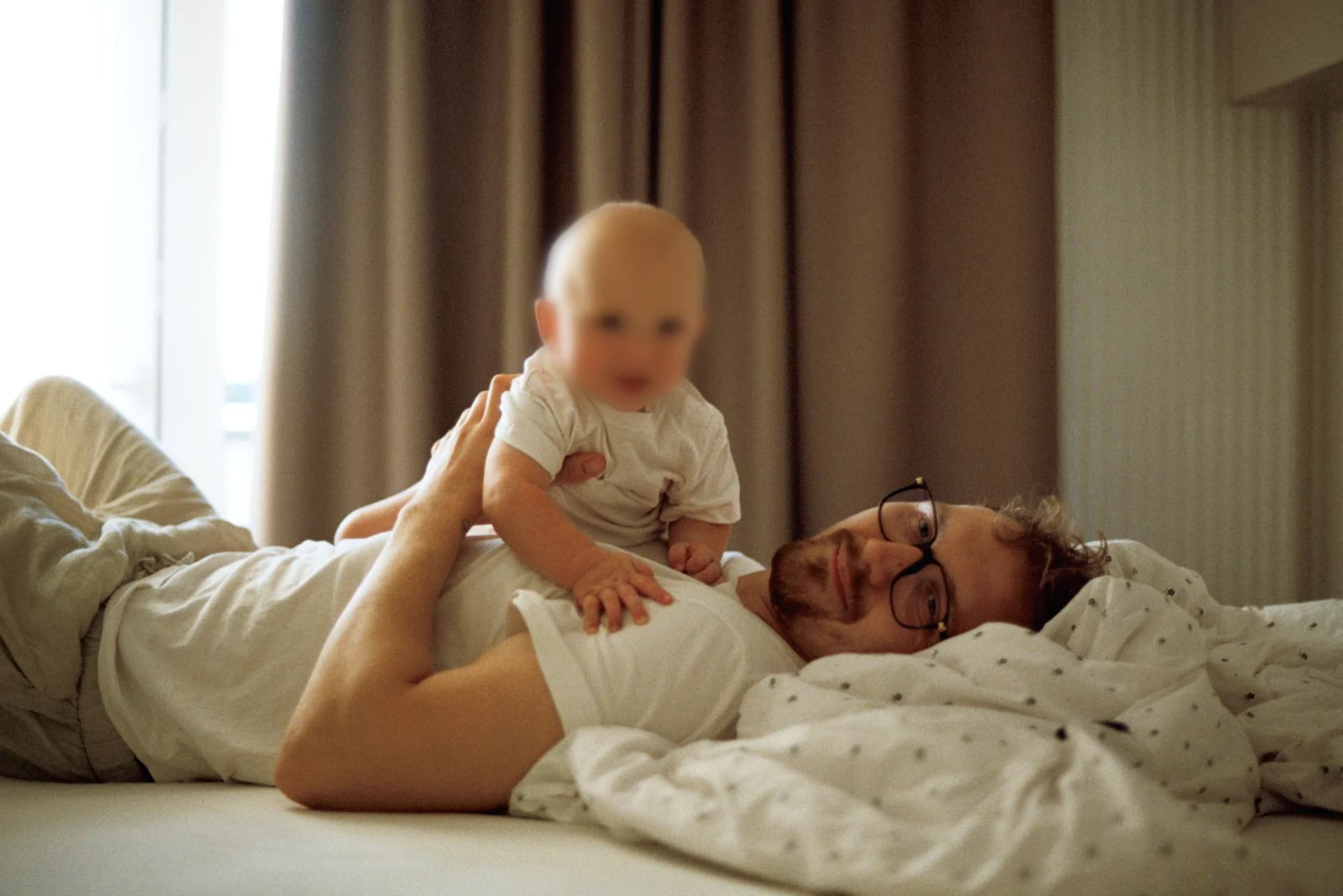
When my son was born, I held him like he was made of glass.
Miriam handled him with a kind of natural confidence I did not have. She knew how to hold him, how to soothe him, how to read what he needed. But every time I picked him up, he fussed. I did not know what I was doing wrong. I was terrified of making one wrong move.
At some point I honestly felt like a visitor inside my own family.
I remember early on there was a night when Miriam was completely exhausted and I tried to take over. I really tried to help but my son just screamed and nothing I did worked. But it wasn't like this for Miriam... or grandma. Just me.
When Miriam was pregnant, an old coach of mine had mentioned acrobatics classes for babies. I remember thinking... okay, sure, sounds interesting; and then I filed the idea away.
After our son was born, it came back. Especially the part that this was somewhere fathers who felt as unsure as I did could actually learn to move with their child.
Then the teacher asked for my son
So when he was about three months old, we walked into a local class. The teacher had been working with children for over forty years. Some of the babies he had taught decades ago were now coming back with babies of their own.
And there were other dads and moms there, for lack of a better word, tossing around their babies.
I didn't really even know how to hold mine properly.
We started with small, natural movements. Nothing too shocking. Then at some point the teacher asked to demonstrate a movement with my son, and my heart sank. With my son?
I looked over to where Miriam was sitting. Like... is it okay if I just hand him over?
But she was already digging through her purse for her phone to film it. So I kind of reluctantly handed him over.
He was calm, completely unhurried, and our son started giggling. Even though it looked a little scary to me, he wasn't scared at all.
That was my first shift.
There was something here I could learn.
What changed after we went home
The more classes we went to, the more changes I noticed outside the class.
I started reading our son's cues better. I could tell when he wanted to keep going, when he had merely paused because something else caught his attention, and when he was properly done and my brilliant plan for that afternoon needed to be retired.
Some days we missed exercises. Some days he wanted to explore the room and had no interest in what I was offering. Other days he was completely there with me, and the whole thing felt less like an exercise session and more like the two of us discovering what his body could do.
Our coach, whom I loved as a person, believed in discipline and in the idea that worthwhile things are not always easy, which I respected. But I also did not want movement to become something we did to our son while he waited for it to end.
So I learned to guide, then pause; to invite him back sometimes, but not force the issue; and to accept that stopping early could be the right decision rather than evidence that we had failed the session.
This was where the class and what I wanted to do at home started to become different things. A class could introduce us to a movement. At home I had to decide whether it fitted that day, how much help he needed, whether the pause meant he was finished or whether he had just spotted something across the room.
The exercise was still there. But now I was learning all the decisions around it, and those were the things I could use again tomorrow.
An impressive movement can leave quite a lot out
If you follow Baby Acrobatics on Instagram, you've probably seen some of the movements that catch people's attention. A short clip is good at showing you what happened. The preparation and the decisions that made it possible are much harder to fit into those few seconds.
Even an ordinary reach shows you the problem. You can see a baby's hand arrive at a toy without knowing whether they reached for it, whether the adult helped part of the way, or whether the adult moved their arm through the whole thing. The end of the movement looks similar, but the baby has done something different in each case.
Once you notice that, you start watching demonstrations differently. Where does the adult help? When do they wait? What is the baby already able to do? And if you try the activity and your baby responds differently, what are you meant to change?
Those are the questions a parent needs answered before a video becomes something they can use. I've gone further into that in how to judge a baby exercise routine.
I knew most parents would never find a class like the one we found. A weekly hour could only cover so much anyway. So I started building the thing I wish someone had handed me the day our son was born.
Why I went so far into this
I'm not a physical therapist. I'm not a pediatric expert. I'm a dad who gets obsessed when something matters.
That started well before I became a father. At twenty-four, I was diagnosed with multiple sclerosis, and I had no idea what I was looking at. I was a film major. I didn't have a background in health or biology, but suddenly understanding those things mattered a lot.
So I started reading, and over the following years I had to learn how to read the research as well. At the beginning every piece of information was disconnected. Trying to understand how it fitted together became a large part of my life, and eventually I spent more than two years researching and writing a book about fasting.
That's the same energy that I built Baby Acrobatics with.
Only this time I had years of that work behind me, and I knew I needed people who understood the things I didn't. I worked with pediatricians, physiotherapists, osteopaths, child-development specialists, athletes and coaches. Then two licensed occupational therapists who did not create the program were asked to find problems and propose fixes, Carissa Heestand and Taimi Santisteban Sosa.
You can see what Carissa and Taimi reviewed, along with their backgrounds, on the program's expert review page.
The longer version of my own background is on our About page. But the question that kept bringing me back to this project was very close to home. How do we help another parent get from being unsure what to do to actually enjoying this with their baby?
What we put inside the program
More exercises alone wouldn't solve that. You could give someone a hundred demonstrations and still leave them standing beside the play mat, trying to decide where to start.
The Blueprint gives you the written foundation. It explains how we think about movement, what to notice in your baby's response and how to make decisions as you practice. Both programs include the exercise library, so you can look up a movement and return to its explanation.
Movement Mastery adds the full video demonstrations and personalized routines. That is where you can see the handling and transitions, and get a selection of activities relevant to your baby's stage. You still watch the child in front of you when you use it. A routine can't know that today they slept badly, or that the thing they usually enjoy has become uncomfortable.
What it can do is give you somewhere to begin and enough instruction to understand what you're trying. Then, as you learn the movements, you have more attention available for your baby instead of spending the whole time wondering what your hands are supposed to be doing.
You can see both programs and what's included before choosing. If making time is the part you're stuck on, the working-parent article is a useful place to go next. We had to work that part out too.
What I wanted at the beginning was to be able to take my son when Miriam needed a break and know what to do with him. Learning changed that for me.
And that's what I want a parent to come away with. You understand something about your baby that you didn't understand before. You know how to offer the next opportunity, when to help and when to let them have a go. The phone goes away and you still know what to do.